Rethinking Eurasian Connectivity: Insights from Telegraph42 at GCCM 2026
Tashkent, Uzbekistan — 2026
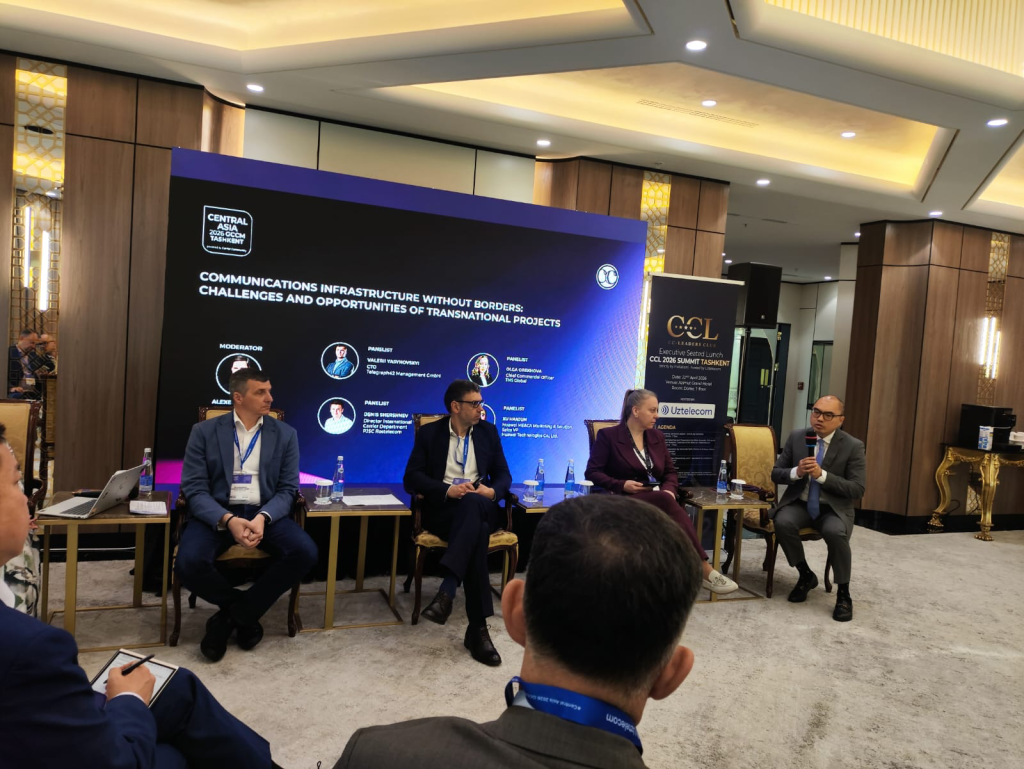
At the Central Asia 2026 GCCM, the Chief Technology Officer of Telegraph42 Management GmbH, Valerii Yasynovskyi, took part in a high-level panel discussion titled “Communications Infrastructure Without Borders: Challenges and Opportunities of Transnational Projects.”
The session brought together leading industry experts to explore the evolving dynamics of cross-border telecommunications infrastructure, with a strong focus on Eurasia’s role in global connectivity.
Rethinking IXPs: From Fragmentation to Distributed Ecosystems
During the discussion, Valerii highlighted that the primary challenge in the region is not the lack of infrastructure, butmarket fragmentation. Traffic remains unevenly distributed across countries, while trust gaps between operators and multi-layered regulatory environments continue to slow down integration.
“From our perspective as a wholesale transit operator connecting Europe and Central Asia, these challenges are part of our daily operations — not only technically, but also operationally and regulatorily,” he noted.
A key issue remains the region’s dependency on a limited number of transit corridors, particularly via Eastern Europe, which introduces both technical and geopolitical risks.
To address this, Telegraph42 advocates moving beyond traditional models:
- Distributed IXP Architecture — instead of a single-location exchange, multiple interconnected nodes across Europe and Central Asia form a unified traffic exchange environment
- Leveraging technologies such as EVPN and VXLAN to create scalable, low-latency interconnection fabrics
- Enabling local operators to connect within their own markets while gaining access to a broader international ecosystem
This model significantly reduces entry barriers and improves accessibility. The use of route-server architectures with flexible policies further simplifies peering, particularly for operators that are not ready to establish multiple bilateral agreements.
Security and trust were also emphasized as foundational elements. The implementation of RPKI and IRR filtering is seen as essential not only for network protection, but also for building confidence between participants.
From an organizational standpoint, neutral governance models — such as consortium-based IXPs — were identified as critical for ensuring broad participation. In addition, the involvement of international content providers and global carriers can immediately enhance the value proposition by bringing traffic into the ecosystem.
“Ultimately, the challenge is not technological,” Valerii concluded. “The technologies are already available. The real complexity lies in aligning stakeholders and building trust in a sensitive, multi-jurisdictional environment.”
New Models for Cross-Border Partnerships and Financing
Addressing the second topic, Valerii outlined how traditional single-operator infrastructure models are becoming less viable in today’s environment due to elevated geopolitical and regulatory risks.
Instead, the industry is shifting toward more flexible and risk-distributed approaches:
- Consortium Models — multiple operators jointly invest in infrastructure and share capacity, reducing individual exposure and facilitating cross-border cooperation
- Anchor Tenant Structures — large customers such as content providers or Tier-1 operators commit to capacity upfront, creating financial stability and enabling project bankability
- Infrastructure-as-a-Service (IaaS) — one party builds and operates the network, while others access capacity via long-term leases or IRUs, particularly relevant for higher-risk routes
Financing structures are increasingly hybrid, combining private investment with support from financial institutions and export credit agencies, especially when European equipment is involved. Additionally, vendor financing continues to play a key role in large-scale backbone and DWDM deployments.
Valerii also emphasized the importance of legal and operational structuring in transnational projects. In many cases, ownership, operations, and traffic flows must be separated across jurisdictions to ensure compliance and efficiency.
“Flexibility is critical,” he noted. “The ability to dynamically adjust traffic flows, capacity allocations, and partnership structures over time is often the determining factor for long-term success.”
Driving the Future of Regional Connectivity
Telegraph42’s participation in the panel reinforces its role as a key architect of next-generation transit ecosystems across Eurasia, actively shaping both the technical and commercial frameworks required for scalable, resilient, and borderless connectivity.